

Today's lineup
















Your AEO checklist
Assess where you’re strong and where you still have gaps in your AEO strategy.
Building for AEO: Ownership, agencies, and execution
This webinar helps close the gap between strategy and execution to successfully operationalize AEO.

WEBFLOW AEO · COMING SOON
Own your visibility in AI search.
See how AI engines find your brand. Get prioritized recommendations. Ship improvements. All within Webflow.
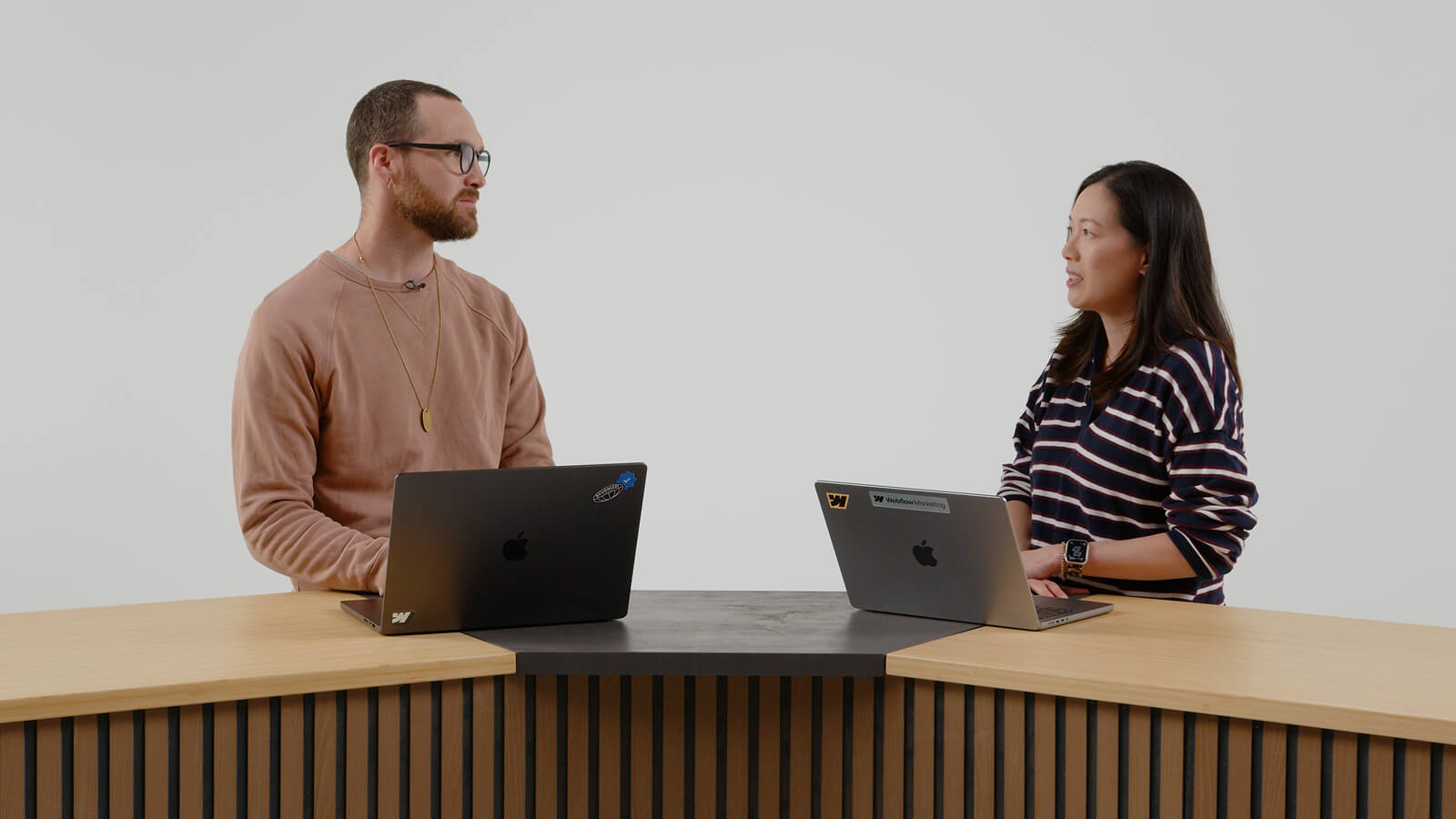
[Alexander Diner] So in the roundtable, we talked about how AI is changing the way people find and evaluate their tools and what that means for brand and marketing strategy. Now we're going to show you what it actually looks like in practice on our own site. I lead design and technical strategy across Webflow sites and Vivian is our amazing AEO and SEO lead. Our team shipped a major redesign about six months ago. When we were building it, we realized the site had to do three things at once they had never been asked to do simultaneously before. So that's where I want to start. Vivian, what are the three things our site has to do and why do they matter now?
[Vivian Hoang] Our homepage has three jobs. It has to represent Webflow visually to a human. It has to signal to AI who we are and who we're for. And three, it has to act as a conversion engine. So we have to make sure that we explicitly tell AI what Webflow is, who we serve, our audiences and all of our features. AI visitors are already arriving to our website more informed. So we need to make sure that our website also acts as a conversion engine and move those visitors down the funnel.
[Alexander Diner] When we were getting ready to redesign our site and you were looking at the way that AI represented us, when folks were asking about Webflow, what did you find? How were people describing Webflow as a product and as a brand versus how we would describe ourselves or want others to describe us?
[Vivian Hoang] When I first started checking AI to see how it portrayed Webflow, we were known as a no code website builder. And there is a perception gap between how AI portrays us and our messaging and our brand narrative. So when we were moving into that redesign, rebuild, we wanted to close that perception gap. And so, from your point of view, what did we have to do structurally or from an architecture standpoint to do that?
When AI is talking about Webflow, it's synthesizing answers from across the web and the homepage is one critical part of that answer. So we had to make sure that we communicated that explicitly in the structure, the semantic HTML and the schema markup.
[Alexander Diner] What did that mean for you, design wise? When we set out to redesign the site, one of the first decisions we made was about simplification. So our previous site, it was built so much around movement and interactions and what this looks like is content that reveals as you scrolled and elements that animated in as you engage, which gives it this sense of feeling alive. And that's so cool. But underneath that, the problem is that crawlers don't scroll or behave or interact with a site in the same way. And so if your most important content only appears after an interaction fires, as far as the machine's concerned, it might not exist at all. So it shifted the way we were thinking about the site — content present on the page from the start, with fewer reveals and fewer gates. And what was interesting is that this actually made the page feel a bit more direct and a bit more approachable for our human visitors too.
And so tell me about all the other components that we're considering outside of our homepage.
[Vivian Hoang] Our website is just one part of the equation. AI uses signals from all across the web. So you're optimizing for the consensus of the web. All of the signals, like Reddit, how people interact with your brand and talk about your brand, YouTube videos, Wikipedia, all your social channels and mentions in third party publications, all of those play a role in how AI portrays your brand.
[Alexander Diner] Let's do this live. If I'm AI, I'm crawling the Webflow homepage right now. It's six months into the redesign. What am I seeing? Can you walk us through that layer by layer?
[Vivian Hoang] So when you visit our homepage as a human, the story is clear, but AI doesn't visit a page the way that you and I do. It doesn't scroll, it doesn't watch the hero animation or see that visual representation of the canvas in Webflow. LLM crawlers don't execute JavaScript or process client side rendering. It reads the code underneath all of that.
[Alexander Diner] With what you just described, it's really shifted the way we think about the job that the homepage has to do. We have two now distinctly different parallel audiences that are trying to kind of learn the same thing in different ways.
An example that I think is really clear is we used to say something like, "you design, we generate the code." And yeah, that explains how Webflow works. It's accurate. But "create brand forward web experiences that wow" is much more descriptive of what they're hoping to accomplish and what we can help them accomplish. So when an LLM is synthesizing an answer about what Webflow does, outcome oriented copy maps much closer to how people are actually asking questions. The way that we're structuring the content, the copy, the design for the homepage needs to be simple, clear enough for our human audiences to get what they need from it, depending on what their role is. But more importantly for this conversation, there's something happening underneath the surface that most visitors aren't seeing, right? Which is that when a crawler or an LLM reads a page, it's looking for structure that it can make sense of. And so a site that's built on consistent patterns gives it exactly that. So what we originally thought of as a design pattern or a design decision turned out also to really benefit our AEO strategy.
[Vivian Hoang] AEO is a journey, and we're continuing to learn. As we experiment, we found that some things worked and some things didn't. Adding an llms.txt file didn't have as much of an impact, but restructuring our content, answering FAQs, adding schema, and refreshing content had a bigger impact.
[Alexander Diner] We've talked a lot about experimenting, but I guess none of it really matters unless we can measure it and track it. So tell me a little bit about how we're thinking about tracking AEO results at Webflow.
[Vivian Hoang] The honest answer is that measurement in this space is really hard, but I think about measuring in three different layers — visibility, citations, and how it impacts the business. So visibility is how Webflow shows up in answers across a set of our tracked priority prompts, how AI portrays us, our brand sentiment and messaging, and then citations is whether we show up in the answer as a link so that we can track that traffic. And then finally the business impact is whether we see AI attributed visitors sign up and convert.
[Alexander Diner] We've been talking about ourselves a lot, but I know there's probably a lot of people watching and they're curious how they can get started on AEO. What would be your top recommendations for them?
[Vivian Hoang] I think most companies focus too much on the tactics and tools without building a strategy. I would start with really understanding your target audience and industry. What are the prompts that your users are using in AI to find a solution like yours so you can use those insights to build a strategy? And I think that's one place where most companies can start.
[Alexander Diner] So does any of this really matter if you don't have a clear brand voice? I would say brand voice matters more now than it has in a long time. So much of the conversation around brand, especially with the web, has been about these visual, beautiful, engaging experiences. But as you said, that's not what folks see on the other side of an LLM when they're asking questions about the best web marketing platform. They're just getting text out the other side. And so having a distinct, unique, memorable brand voice is more important now than it has been in a long time.
And that's where we are with our own site. Still learning, still adjusting. Up next, Brett, our senior group PM. He's going to walk through the new Webflow AEO tools that are taking what we've been doing manually and making it available directly on our platform. And on Thursday, our documentary will bring the whole story together. Thank you for watching.