
Today's lineup

















The 2026 State of the Website
Find out how 1,000 marketing and technical leaders are adopting AI.
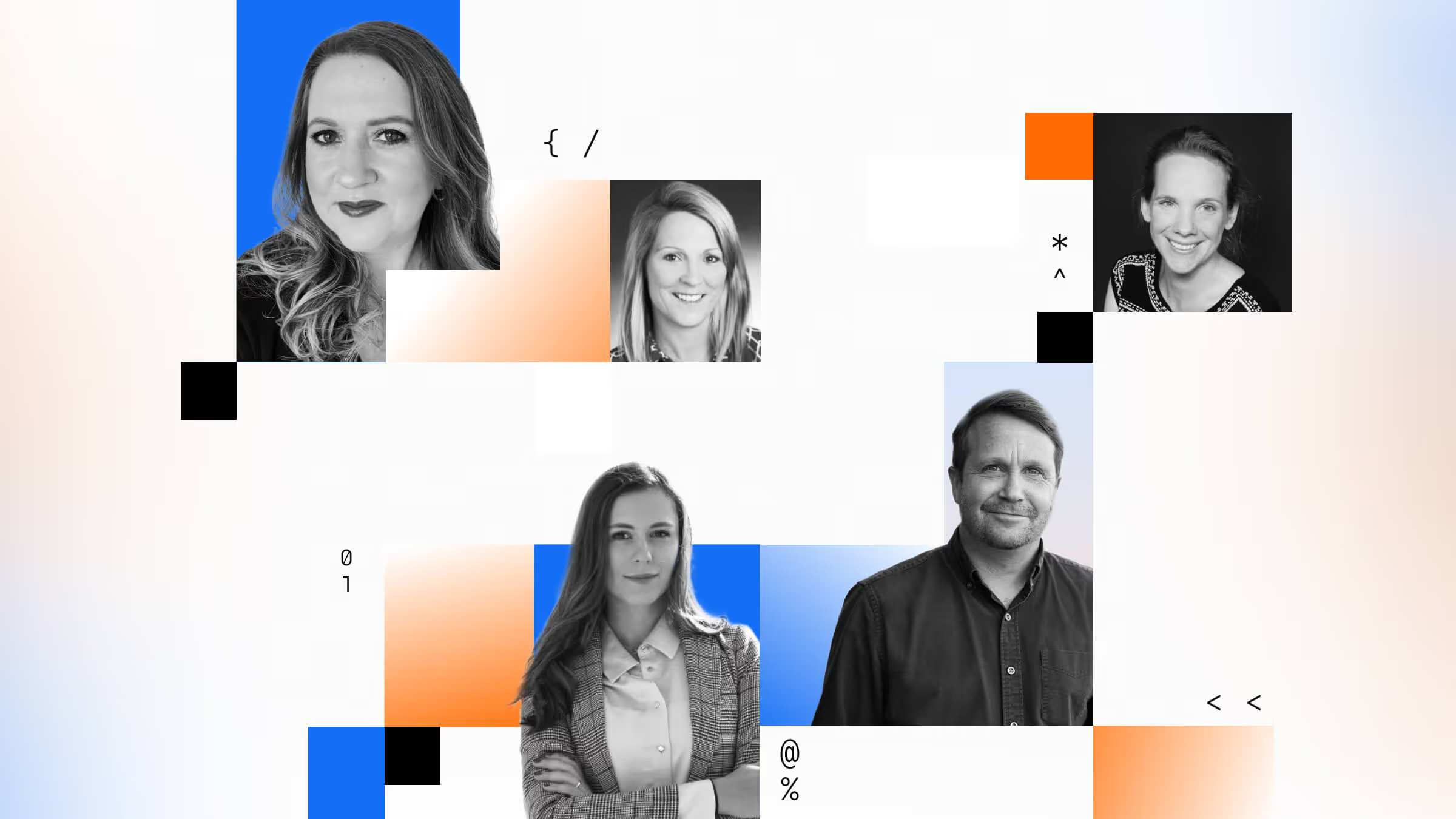
The AEO readiness gap: What leaders are getting wrong
AI is already shaping how buyers find you. So why do only 26% of practitioners say they're implementing AEO? Senior marketing leaders weigh in.
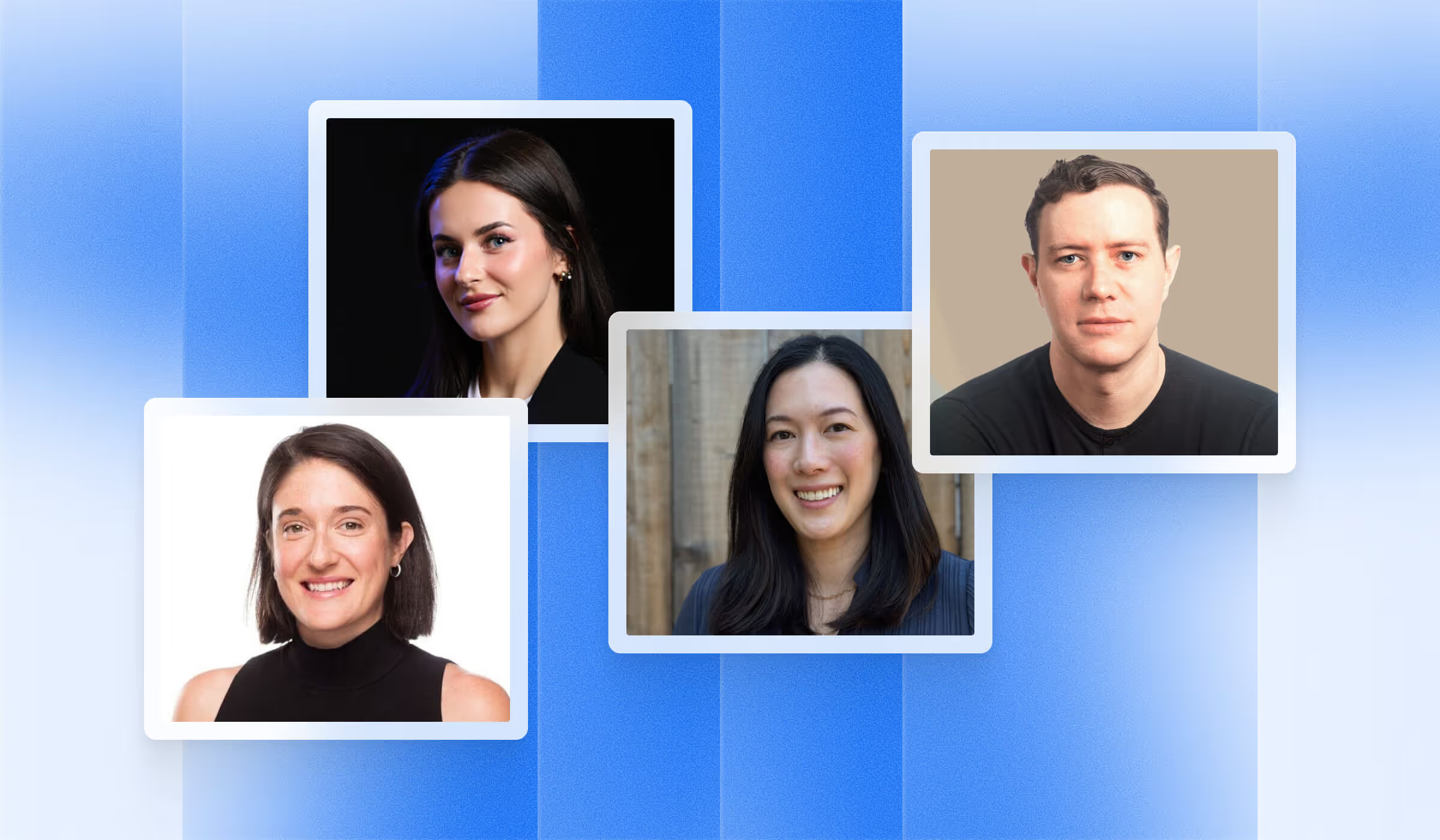
How to fuel AEO authority with earned media insights
Reddit, Graphite, and Webflow discuss how to authentically capture insights to improve AEO visibility.

The AEO playbook
Learn how our research-backed framework sets you up for AEO success.

WEBFLOW AEO · COMING SOON
Own your visibility in AI search.
See how AI engines find your brand. Get prioritized recommendations. Ship improvements. All within Webflow.
[Marissa Kraines] It's Thursday premiere day. Sadly, if you're just tuning in, you missed the red carpet. But I can assure you my outfit ain't no crumbs. I told you Monday this was all building to something. I reiterated it Tuesday. I reminded you again yesterday. At some point that's either called a narrative arc or we were worried you were distracted with multitasking. Either way, the day is here.
The documentary is called Own Your Narrative. Not a product demo, not a keynote. A story about an industry-wide reckoning. The moment the web stopped being designed just for people and started being read and represented by machines. You're going to hear from the people who were in the middle of this shift before anyone had a name for what was happening. Their brand showing up wrong, their story getting lost, their customers getting a version of them that wasn't them. You'll also hear from people inside Webflow who are betting the company on this being the most important shift in the web since mobile.
From Alexander and Vivian, who you saw yesterday, building the answer in real time. Turns out they do that a lot. How? They're treating webflow.com as customer zero. Talking the talk and walking the walk. But the voices that matter most are the ones outside the building, the ones with nothing to sell you, just something to say. Something we think will ring true for those paying attention. So without further ado, the world premiere of Own Your Narrative.
[Linda Tong] When I think about the transformation that happened in mobile and compare it to where we are right now, it is incomparable. Mobile really just took you from form factor transformation, but you were still doing a lot of the same activities. You were still looking up information, looking at maps. With AI, it's transforming everything because it's not about a new UI, it's not about fitting on a smaller screen, it's not about suddenly being able to do something on the go, but rather it's synthesis. It's being able to understand massive amounts of data, compute them and turn them into results. Whether it's answering questions really easily, whether it's researching something, running workflows that can actually operate on your behalf, it's actually shifting where you spend your time, how you do it and who does it.
[Josephine Cahill] I got a DM on Slack from one of our sales team who said, Josephine, someone said they found us on ChatGPT and that our price is half of what our price is. And they found a link and it was a page from, I think, 2021 and we didn't know what to do, we didn't know whether to honor that or not. But they out-negotiated us in that context very well. And we realized we had to get ready for AI search as fast as possible.
[Oana Manolache] We were doing an RFP for a big customer of ours and I remember the team was working so hard putting so much information together and the customer sends us this comparison with the other players in the market and I'm like, this is all wrong. Where did they get this from? We do a lot more — like, this is not correct. And their answer was, well, we put it in ChatGPT, we put it in AI and this is what we came up with.
[Joe Mulvihill] A lot of people think that they have been doing SEO for a while and so that they're completely squared away and they're good to go on that front, and that that gives them a leg up. But it's not the end-all be-all.
[Coco Vega] The biggest mistake people are making right now is ignoring AEO.
[Paolo Provinciali] Now marketers and marketing organizations have to do more in order to have presence and be relevant in the conversation. If you're not part of the conversation on LLMs, no one is ever going to visit your website or people are not going to try to do more research about your product or company. And therefore being invisible in that discovery process is the really terrifying part because you cannot track it.
[Adrian Rosenkranz] 12 months ago, AI search never came up in a deal. Now there isn't a conversation, not even a deal, a conversation that I don't talk about how traffic is changing and how that's impacting a business. How do you win in a world where AI is placing judgment on your brand, on your product before customers even find you?
[Dave Steer] We were looking at our data. The amount of traffic that we were seeing coming to Webflow was actually plummeting and we knew that we had a problem. We knew that if we're experiencing this issue, it is very likely that our customers are experiencing the same issue itself. In order for us to help solve the problem, we needed to be the first customer. What we call customer zero in addressing the problem for ourselves as well.
[Guy Yalif] The playbook — it starts with your own site. You begin by answering the questions your prospects are asking throughout the funnel in depth for the humans. And then you make it really easy for the machines to understand the structure and meaning of your site in a concise, efficient way. If you've done those two things, the next thing to think about is how you appear off your site. If you have a Wikipedia page, is it accurate? If you're in Yelp, is that accurate? If you're in G2 or TrustRadius or any of the others, are those accurate? There's incrementally higher value because those are incrementally sourced and referred to more by the LLMs today.
[Guy Yalif] Upper funnel, LLMs tend to cite other places, whether that be review sites like G2, communities like Reddit and LinkedIn, or YouTube. Mid funnel, they may use some of your content. Lower funnel, they tend to go directly to your website. So what you are doing on your site is the foundation for all of it.
[Joe Mulvihill] The question isn't whether AI is going to read your website. The question is, are they going to trust it? What I'm telling every client right now is that they have to become the trusted source of information from an AI search perspective, from a user perspective, from their audience perspectives as well, because trust is going to be the new currency that everybody is focused on.
[Dave Steer] I often talk about marketing as a verb, not a noun, and as a team sport. There's nowhere better to create the team sport of marketing than answer engine optimization, because in order to get it right requires not just the SEO and not just the site builder, but everybody working in concert together. And so I asked Alexander and Vivian, two of our primary leads, to really take a look at what can we do across the marketing team to have an impact in how we show up in answer engines.
[Alexander Diner] Vivian, in terms of how AI represented us, how far off was it from how we would describe ourselves or want others to describe us?
[Vivian Hoang] Yeah, when I first started looking at how AI was describing Webflow, we were traditionally known as a no-code website builder. And there is a perception gap between what AI says about us and what we say about ourselves. When you visit our homepage as a human, the story is clear. But AI doesn't visit the page the way that you and I do. It doesn't scroll, it doesn't watch that hero animation or see that visual representation of the canvas in Webflow. LLM crawlers don't execute JavaScript or process client-side rendering. It reads the code underneath all of that. So we had to make sure that we communicated that explicitly in the structure, the semantic HTML and the schema markup. What did that mean for you, design-wise?
[Alexander Diner] When we set out to redesign the site, one of the first decisions we made was about simplification. So our previous site, it was built so much around movement and interactions. And what this looks like is content that reveals as you scrolled and elements that animated in as you engage, which gives it this sense of feeling alive. But underneath that, the problem is that crawlers don't scroll or interact with a site in the same way. And so if your most important content only appears after an interaction fires, as far as a machine's concerned, it might not exist at all. So it shifted the way we were thinking about the site — content present on the page from the start, with fewer reveals and fewer gates. And what was interesting is that this actually made the page feel a bit more direct and a bit more approachable for our human visitors too.
So much of the conversation around brand for years, especially on the web, has been about the visual side of things. These beautiful, polished, interactive, engaging sites. But as you said, the AI — they don't see any of that. And what comes through on the other side in an answer engine is just text. And so having a distinct, unique, memorable brand voice, I would say is more important than ever before.
[Guy Yalif] Vivian Hoang, who runs our SEO AEO team, tried putting a table of contents on a blog. In four weeks she got 40-something percent more traffic from LLMs and 20-something percent more traffic from search engines — for a table of contents. She said, great, I'm going to put this in all of them. We're going to build that into our template. There are many such low-hanging fruit awaiting for us in AEO. Those that aren't participating in this are missing out on all of that.
[Joe Mulvihill] Every brand has an opportunity to optimize the website from an AEO perspective. The activities that we're talking about are going to be elements that you can do whether you're a small operating website or if you're a large enterprise system.
[Maura Ginty] We're seeing more traffic coming in through AEO. I think we were at like 125 searches that would come through a month and we're up to now over 400. The numbers show for themselves. We saw a 37% increase in engagement. We saw an incredible bump in demos.
[Carol McNerney] I think people need to be careful not to get overwhelmed by AEO. Oh my gosh, I have to do 25 things. I have to buy this, I have to buy that. There's educational content that you can put on that you probably have — just refresh it, get the Q and A, work with the meta, you know, the tagging, the schema. It may seem incremental work, but it makes major impact.
[Coco Vega] Start experimenting with your page title, with your meta description. Make sure that schema and structured data are everywhere that you need it to be. Start adding FAQs into different parts of your site and measure the results that you get in there. You can create new tests. You can use Optimize to experiment with your site and see what gets better results based on that. Then you can continue making improvements on your site every single day.
[Inna Meklin] In this world of AI search, where traffic no longer really tells the story, it's really all about visibility. What are the topics related to your brand that you absolutely must show up in? Are we in the conversation? Is our brand there? Setting a baseline, testing and iterating and watching that baseline change over time.
[Rachel Wolan] We saw a tremendous adoption of the first version of our AI SEO and AEO product, but it was very scoped to an individual page and the number one ask was, how can I do this across my entire site? And then as the new agent frameworks started to roll out over the last six months, we realized that it didn't need to just be a workflow, it could be something that could be done autonomously.
[Brett Domeny] So what are we building now? Well, at its core, we're building an agentic closed-loop system for improving your visibility in AI search from insight all the way through execution without requiring deep AEO expertise. When we rebuilt webflow.com, we found gaps we didn't expect. Places where AI was misrepresenting us because the structure just wasn't clear enough. And every one of those gaps shaped what we built into the product. What our team had to identify manually, the product can now surface automatically. You can see how AI sees your site, get specific recommendations and publish fixes the same day. So what took us weeks to figure out on our own site, the product can do in minutes.
[Rachel Wolan] Our goal in actually identifying this product is to make it easy so that any brand can go and roll this out. You're not just trying to optimize for one search engine. It's ChatGPT, it's Claude, it's Perplexity. And then you're also trying to optimize for it in different languages across different audiences. So I think that's what makes this challenging, is it's really a multidimensional problem. And this is not a problem that a single human can go and really go and solve themselves. This needs to be solved by a team of agents that's working for you. Agents can learn off of behavior that's happening on your site. They're coming up with ideas and they're looking at competitors, they're looking at all kinds of different ways in which you want to be known in the world.
[Joe Mulvihill] There's definitely a first mover advantage that comes into play. In five years, the companies that are starting to build for discoverability AI now are going to be far ahead of those that have not taken that leap yet. This is another channel like search was another channel, like mobile was another channel, like social was another channel.
[Dave Steer] We as marketers now have an even bigger surface area across which to keep our brand consistent.
[Guy Yalif] The teams that are focused on AEO today, they are routinely day in, day out, putting double-digit lifts in traffic up on the board. That is not an exception.
[Linda Tong] We're all in on AI and the agentic web because frankly that's the only future that exists. Agencies and freelancers alike have a huge opportunity to help bring customers into that future. They are going to go to them to understand how do I build agentic workflows.
[Coco Vega] I think that this is one of the biggest shifts that we've seen, if not the biggest that we've seen. And it's also really interesting because we're having a direct impact in that new version of the Internet. Every single change that we make on a website can result in different answers, in better results, on answer engines. It's never been easier to do it and the opportunity has never been bigger.
[Linda Tong] We have been spending our entire company history understanding the needs of marketers, the needs of entire marketing teams and their digital assets. We understand the problems, we know how to build the technology and that's all we want to do. We see this moment and we're going after it.
[Paolo Provinciali] I think that the advent of AI is gonna help us go through a marketing renaissance. Because great marketing isn't about converting the people that were gonna buy anyways. It's about persuading and convincing people that weren't thinking of you, your brand and your product in the first place. And the only way to do that — and then leveraging the incredible power of AI — is to go back to the marketing fundamentals to understand actually how you position your brand, your product, how you speak to your audience. But when you combine that with what this AI technology can provide and you bring together the art and the science of marketing, then the future is limitless.