.png)



68% of leaders think they're AEO-ready. Only 26% of practitioners say they're actually implementing it.
That's not an execution lag. That's a signal.
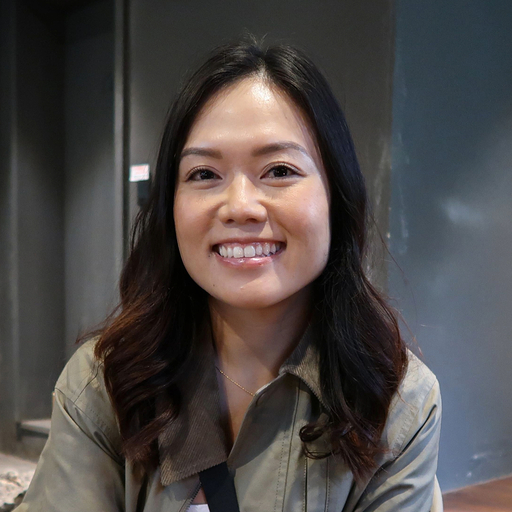
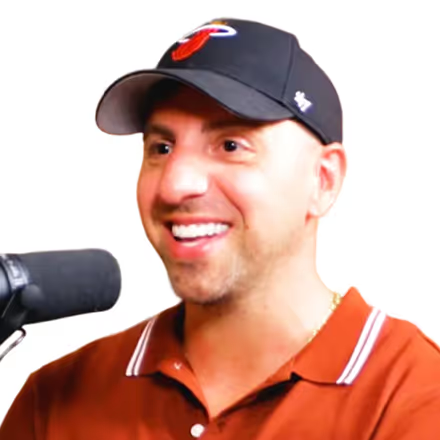
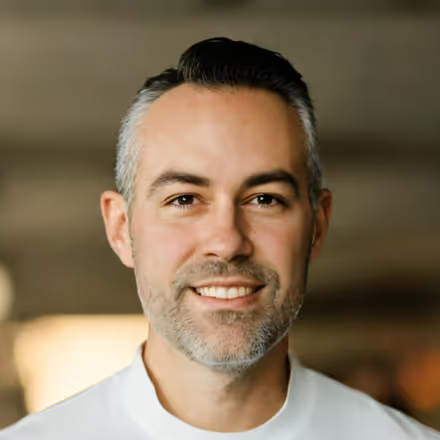
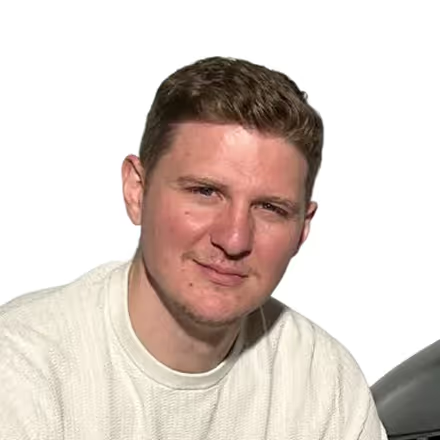
We brought CMOs and senior marketing leaders from Webflow, Maven Clinic, LinkedIn, Sequel.io, and Walker & Dunlop into a room and put one proposition on the table: most companies think they're ready for AEO, but aren't.
What followed wasn't a debate about the real and present impact of AI search. It was a harder conversation about what readiness actually requires, why confident leaders keep getting it wrong, and what needs to change starting now.
The execs in this roundtable took it live on Flow TV. Watch the discussion free.
The confidence trap
The gap between 68% and 26% isn't a surprise. It's a feature of how leaders process complex, fast-moving challenges. As Maura Ginty, CMO at Maven Clinic, put it: 87% of people believe they're above-average drivers. The math doesn't work, but the confidence is real — and the same psychological dynamic is playing out in boardrooms across the industry right now.
The pattern is predictable. A leader spots AEO on the horizon, launches a task force, distributes ChatGPT licenses, and declares the problem addressed. But as Carol McNerney, CMO at Walker & Dunlop, noted: "Unless we give them use cases and train them — and have them actually do it — I'm giving my team a very powerful tool they don't know how to start with."
This is the confidence trap. Leadership declares readiness. Practitioners inherit the complexity. And the gap widens quietly.
What makes it worse is the framing. AEO isn't a project with a finish line — it's an operating posture. New models, new platforms, new ranking signals emerge constantly. The question was never “are we ready?” It's “how are we preparing every single day?”
What AEO readiness actually looks like
Before platforms. Before distribution channels. Before the debate over Reddit versus YouTube. Companies need to answer a more foundational question: do we actually understand our own content?
"A lot of companies think they're AEO-ready because they did great SEO," said Oana Manolache, Co-founder and CEO of Sequel.io. "But SEO rewarded volume. AEO punishes inconsistency."
AI doesn't read your website. It synthesizes your brand from everything — owned content, earned media, review sites, social platforms, third-party publications. If those signals don't tell a coherent story, the inconsistency doesn't just persist. It compounds.
That's why the first real step, as Inna Meklin, Director of Digital Marketing at LinkedIn, described it, isn't publishing more — it's understanding what AI is already saying about you across every channel you don't control.
At LinkedIn, this meant assembling a 20-plus person task force across PR, social, paid media, product marketing, and integrated marketing — teams that had never formally worked together before. "It's about rethinking the operating model," Inna said. "Companies have all the pieces. They just need to activate them differently."
The resources aren't the problem. The orchestration is.
The website's role hasn't disappeared. It's shifted.
Two myths keep circulating about AI and the website: that you need a separate "AI website," and that the website doesn't matter anymore. Both are wrong. But the role has changed, and most leaders haven't caught up to what that means in practice.
Discovery now happens in AI. Conversion still happens on your site. Inna put it plainly: recent data shows 94% of the B2B buyer journey starting in AI, with many buyers moving through discovery, consideration, comparison, and purchase intent — all within a single conversation — before ever clicking through to a brand's website.
The result is that when someone lands on your site, they already know who you are. Traffic is down, but intent is up. Walker & Dunlop saw AI-referred sessions climb from 125 to over 400 per month after making a handful of targeted changes: adding Q&A to pages, moving PDF content onto indexed web pages, tightening schema, cleaning up meta tagging. Not a rebuild — a repositioning of what the site is there to do.
"The role of the website is more important than ever," Inna said. "It's the final closing point after AI introduces your brand. Your job is to confirm it, convert it, and make the case that what the buyer heard about you is true."
















The AEO playbook
How to optimize for AI-driven discovery
Measuring what actually matters now
If the buyer journey has changed, the metrics dashboard has to change with it. Traffic was always a proxy — now it's a misleading one.
"Traffic could be bots. Traffic could be students doing research. That doesn't mean it's your ICP," said Oana. Instead, she tracks engagement, time on site, and first-party data capture: signals that tell you whether the right people are arriving and whether the content is actually working.
In an AEO world, visibility precedes traffic. Being present in AI conversations happening in your category — across your site, social, earned media — is a mindshare play that has to come before you can even measure the downstream impact. "If you're not visible when the conversation is happening," Oana noted, "you've missed out on that revenue without ever having been considered."
That's a hard message to bring to a board that's still watching session counts. Maura knows the tension well — her board wants pipeline, full stop. The CMO's job now is to build the bridge: channel-level signals like AI referral volume and engagement rates on one end, revenue contribution on the other, and an ongoing education effort to explain why declining traffic isn't a red flag but a sign the funnel is front-loading in AI.
What the 26% are trying to tell you
The practitioners who are actually implementing AEO aren't behind. In many ways, they're ahead — and they're seeing things leadership isn't.
They're the ones rebuilding workflows from scratch. They're the ones staring at questions no one has clean answers to yet: Which tools actually measure AI narrative? How do you coordinate content calendars across PR, social, and web when those teams have never shared one? How do you write for an LLM and a human reader at the same time?
The gap isn't just execution speed. It's visibility. Leaders declare readiness from altitude; practitioners feel the friction at ground level. Carol's advice was direct: "Listen to your team. Get them together. They're the practitioners on the street — you should be guiding them with the right tools, but make sure you're listening to them."
There's also something worth watching at the junior end of the org. Maura described a hackathon where junior team members are being handed use cases to lead. Oana sees a near-term future where managers are overseeing both humans and AI agents and the people most ready for that shift aren't always the ones with the most experience. The confidence gap isn't just a leadership problem. The real AEO work is happening at a level most leaders aren't close enough to see.
What to do about AEO this week
The question isn't whether AEO is happening. It's what you're doing about it right now.
Audit what AI is saying about your brand across owned channels and everywhere you don't control. Stop measuring traffic as a primary success metric. Start tracking visibility, engagement, and first-party data capture as signals that your content is reaching the right people. And get your content, PR, and social teams in the same room with shared OKRs. The operating model that won in SEO won't win in AEO.
AEO is a team sport. Learn more about how to bring that to life with Flow TV.

Own your narrative
Tune in to FlowTV to hear real stories from the brands rewriting the rules of AI search.

.jpg)