


What happens to your brand when AI is the one making the recommendation, before your buyer ever visits your site?
That’s the question reshaping how marketers think about discoverability. For the last two decades, the answer was search engine optimization (SEO). As AI changes the rules, that default is shifting — and to understand where things are headed, it helps to understand how we got here.
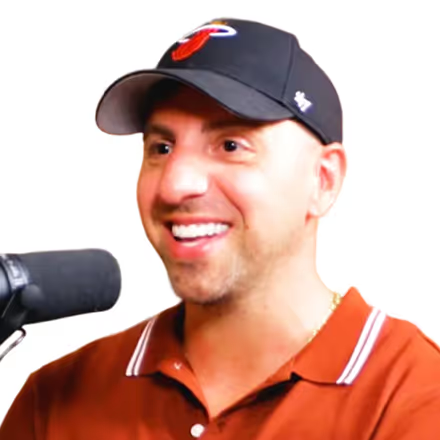
We tapped three experts to weigh in: Vivian Hoang, Webflow's AEO and SEO lead with a long track record in search; Marissa Kraines, Webflow's VP of Brand; and Cat Goetze, the creator behind @askcatgpt who's built an audience of over a million people by making AI accessible. Cat also runs her own brand, giving her a front-row seat to how real consumers are changing the way they find and evaluate products.
The experts behind this piece took it live on Flow TV. Watch the full conversation free.
When showing up was enough
Before search engines, discoverability was largely a presence problem. As Vivian recalls: “All you had to do was have a website, maybe be listed in a directory, and you had a presence.” There was no algorithm to beat, no ranking to chase, no online communities or discussion threads to speak of. Then, Google changed that by making position a prize worth competing for.
Google changed a fragmented search landscape — early engines gave you lists with no reliable way to judge what was worth clicking. By ranking results based on credibility and relevance, it became the dominant interface almost overnight. As Vivian puts it: "The whole SEO industry grew up with Google."
How SEO became a discipline
Once Google became the dominant place for finding things online, position was everything. The promise was simple enough: rank higher, get the click. But executing on that promise turned out to be complex, and an entire discipline built up around it: keyword research, backlink strategy, technical site health, domain authority scores, content optimization. If you were serious about being found, you had an SEO strategy, and you probably had people whose entire job was managing it.
Vivian has lived through every iteration of this. "I've been through a lot of shifts in SEO — Mobilegeddon, voice search, AMP. But all of those shifts proved that SEO as a role and an industry was more important than ever." Some of those shifts mattered in real and lasting ways. Most didn't, at least not in the sweeping, everything-changes sense that the hype suggested. But this one was different. For the first time, it wasn't just the platforms changing, it was the fundamental way people were searching for brands. That distinction is what made the shift impossible to ignore.
Then AI rewrote the rules
With the introduction of AI search (like AI Overviews, Claude, ChatGPT, and Perplexity), we're experiencing a shift from a results page full of links to a single recommended answer. We started noticing the platforms and behaviors shifting first — Google surfacing more answers at the top, users migrating toward ChatGPT and other AI search tools — and then our team started seeing it in the data.
The users arriving via AI weren't just converting at higher rates than non-branded search traffic — they were arriving already sold. By the time they hit our site, the research was done, the comparisons had been made, and AI had already pointed them in our direction.
The volume accelerated fast. In Q4 2024, 2% of Webflow's total signups came from AI. Within six months, that had grown to 8%, more than a 4x increase. With that kind of volume flowing through AI search, and users relying on it to surface the right brand for a specific question or need, the importance of being one of those cited sources is clear, and getting there follows a different set of rules than earning a page one ranking.
AEO: the shift from rankings to answers
With answer engine optimization (AEO), the goal is to show up as the answer when someone asks a question relevant to your brand, product, or category. It's a shift in what you're optimizing for: not the click, but the answer. As Vivian explains: "AEO is an evolution of SEO — it doesn't replace it, it builds on it. A lot of the things that worked for SEO still work for AEO, but now you need to expand all of the different areas you're optimizing. It's not just your content, it's all of the places that mention your brand."
The optimization surface is no longer one site. AI synthesizes the consensus of the web — your own content, yes, but also third-party publications, community posts, reviews, and the conversations happening in places you may not even be monitoring.
Cat experienced this firsthand when she searched for her own brand in an AI tool. "I found links to Reddit threads that were talking about my product that I didn't even know existed. Not only are they getting linked, they're getting linked so much that they're actually surfacing new things that I have not found through regular Google searches."
It's a reminder that the web is already full of conversations about your brand — AI is just making them impossible to ignore. The inputs are broader than they've ever been, and so is the opportunity to influence how your brand shows up.












The AEO playbook
How to optimize for AI-driven discovery
AEO is everyone’s opportunity
When AI becomes the primary interface between your brand and your buyer, discoverability becomes a brand problem, a content strategy problem, and a company-wide opportunity. One team might own AEO operationally, but the inputs that determine how your brand shows up cut across the whole organization.
"AEO is actively informing where we concentrate our brand marketing dollars. When you understand that everything — social, community, PR, the conversations happening about your brand across the web — all feeds into how AI surfaces you, it refocuses your energy entirely." — Marissa Kraines, VP of Brand, Webflow
The shift is also forcing a rethink of who — or what — you're actually optimizing for. Cat frames it simply: "In the entire past of human product development and discoverability, it's been about how we get in front of human eyeballs. But what if the eyeballs aren't human anymore? If they're AI agents doing the shopping and searching for us, do they care about the same things? Do they prefer to read a product review in markdown format as opposed to a really pretty blog post?"
It's a question Vivian has an answer to: "You need to make sure your messaging comes through for humans, but also that your content is structured and machine-readable for agents." Your website is now serving two audiences simultaneously, and optimizing for one without the other means leaving something on the table.
Optimizing for more than one answer engine
The current landscape includes multiple LLMs, each with different training data, different citation behavior, and different signals for what makes a source worth surfacing. A brand that shows up in ChatGPT responses may be largely absent from Claude or Perplexity. Content that Google rewards may not be what an LLM surfaces when someone asks a category question.
And the sources being cited aren't always the ones marketers think to optimize. The most-cited domains vary by industry — for some brands it's Reddit threads and community forums, for others it's trade publications or LinkedIn. It depends on your audience, what they're searching for, and where they look. Knowing your audience is the foundation of any strong AEO strategy, and can help you to navigate the nuances between answer engines.
How to show up as the answer
Start with an audit. Ask ChatGPT, Claude, Perplexity, and Gemini who the best solution is in your category. Ask them to recommend tools for the specific problems your customers are trying to solve. Note where you show up, where you don't, and what sources they're pulling from when they construct their answers. That’s your baseline. From there, it’s a lot of fundamentals:
Audit your brand messaging. Your brand should speak directly to what you do, who you’re for, and what problems you solve — for both the humans landing on your site and the machines crawling it.
Clean up your structured data. Make sure your content is directly and specifically answering the questions your buyers are asking.
Build measurement discipline. Track AI-referred traffic over time. The frameworks are still maturing, but the signal is real and the sooner you start tracking the better.
The excitement around AEO is palpable — and it's showing up across the whole organization, not just on the teams that have traditionally owned search. When marketing leaders get hands on with AEO, they get it immediately. The playbook isn't written yet, which means the opportunity is wide open for everyone.
“You don’t need to have it all figured out. You just need to start paying attention to what AI is saying about you. That’s step one.” - Marissa Kraines, VP of Brand, Webflow
To go deeper on AEO and what it takes to show up in the answers that matter, watch our FlowTV series here.

Own your narrative
Tune in to FlowTV to hear real stories from the brands rewriting the rules of AI search.
.png)
.jpg)