



Everyone's talking about how fast they can build, but only a few are talking about what happens the moment you hit publish.
That's the hard part: governance, security, performance, experimentation, and continuous optimization. AI has made it possible for any team to build anything and, honestly, that's exciting. The build problem is solved. The question now is how you run what you've built. How you govern it, improve it, and make it compound over time.
That's the question that drives how we're building Webflow.
I've been a marketer long enough to have watched this pattern play out more than once.
When e-commerce broke open, teams raced to get the catalog online. The ones that won weren't the fastest publishers. They were the ones who figured out the website was a system. Every transaction could make the next one smarter.
Then performance marketing. Then mobile. Then the martech explosion. Same pattern every time: a new capability makes creation accessible, teams optimize for speed, and the winners turn out to be the ones who built systems around the capability rather than just using it.
AI is that moment again. And having watched this play out enough times, I'd rather say the uncomfortable part early: the teams optimizing for how fast they can build are making the same mistake I've watched teams make before. The capability isn't the advantage. The system is.
Think Formula 1, not drag racing
Any team can put a fast car on a drag strip. Straight line, full throttle, done. That's vibe coding. Pure speed over a short distance, and it's thrilling.
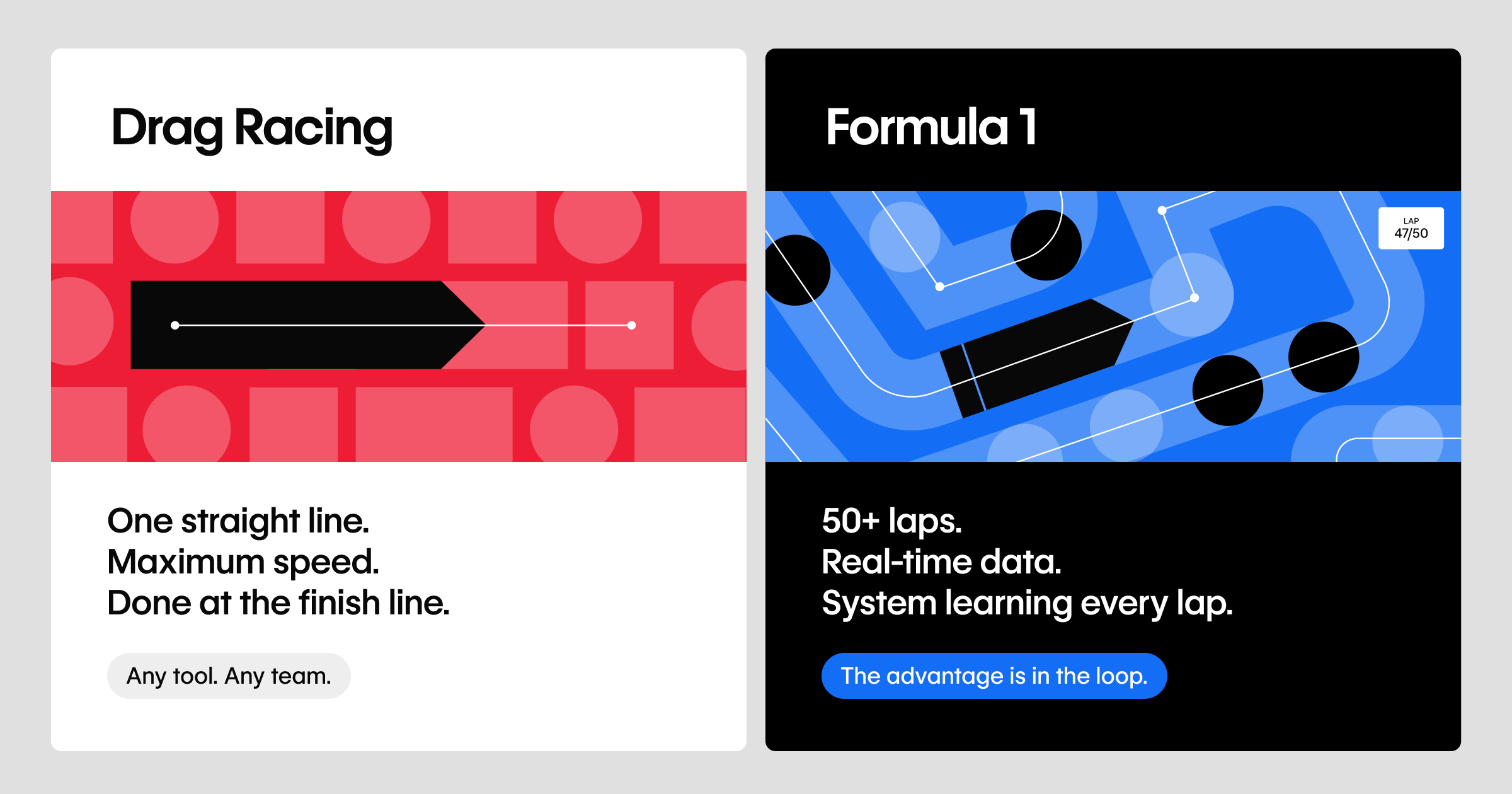
But a real race isn't a drag strip. It's 50+ laps. What separates winners is the pit crew, the real-time telemetry, the micro-adjustments being made every lap because the system is learning. The competitive advantage is the continuously optimized loop. It’s not speed alone.
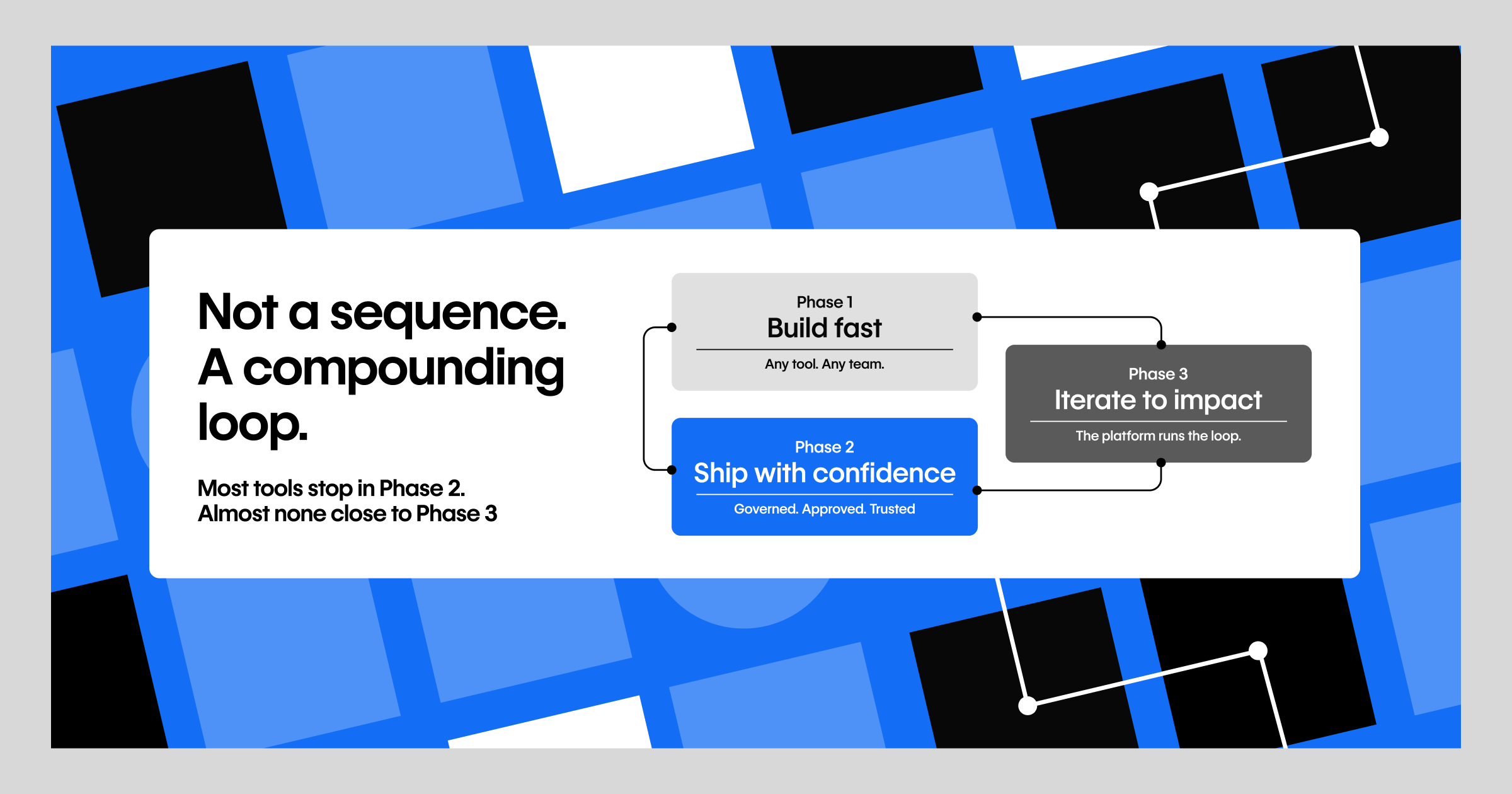
Your website works the same way. Think about it in three phases, as a closed loop that compounds on itself.
Phase 1: Build fast. Agentic development wins here. From prompt to published in hours. Marketers, designers, and developers all move in parallel, generating and iterating without waiting on each other. For this phase, almost any tool works.
We build webflow.com this way ourselves. Our marketing team uses Webflow AI to generate and iterate on pages — campaign landing pages, feature pages, localized content — without waiting on engineering. Whether you're an in-house team or an agency building for clients, the build happens in the platform from the start, which means governance and design system integrity are never retrofitted. They're just there.
Phase 2: Ship with confidence. Before anything goes live, the platform ensures it should go live. Governed workflows, approval chains, collaboration and feedback loops are all built in. This is where brand integrity stays intact, compliance gets enforced, and the whole team signs off without a single email thread. Speed means nothing if what you ship breaks trust.
When governance is built into the platform, your team moves fast because the system already knows what "correct" looks like.
Phase 3: Iterate to impact. This is the moat and almost nobody is talking about it yet. Once live, the loop of behavior → changes → outcomes runs continuously. The platform sees what's underperforming, generates the hypothesis, ships the change, measures the outcome, and feeds it back in.
Most tools get you through the first phase. Some get you through the second. Almost none close the third loop, and none do it without a platform built for all three.
On our own site, experimentation is a standing operating rhythm. Our team runs AI-driven tests through Webflow Optimize without filing a ticket or waiting on a developer to instrument the test. A marketer identifies a hypothesis, sets up the variant, and the test goes live inside the same governed environment where the page was built. When something wins, it ships. When it doesn't, it doesn't. The loop is tight because the tooling is unified. There's no handoff between "the team that builds" and "the team that tests."
The clearest example of this on our own site is AEO. We've instrumented webflow.com to be continuously optimized for answer engine discoverability, not as a one-time audit, but as a closed loop. The platform monitors how AI-driven search engines are citing and interpreting our content, surfaces gaps, and feeds recommendations back in. Our SEO team reviews and acts on those signals, but the system is doing the detection and prioritization work that used to require a manual audit cycle. We're seeing meaningful improvement in how Webflow shows up in AI-generated answers, directionally the right results, building consistently rather than in spikes.
As Webflow's CPO Rachel Wolan put it in a recent Forrester report: "Creativity now flourishes at machine speed, guided, rather than replaced, by human judgment." Designers shift from building single assets to defining pattern libraries AI can generate from. Editors become real-time quality control, turning the stack into a self-improving engine instead of a patchwork of manual handoffs. The site that never stops improving. The teams that win are the ones whose platform iterates for them.
The illusion of efficiency
Here's what makes building without a platform particularly dangerous: it doesn't feel like a problem at first. It feels like the opposite.
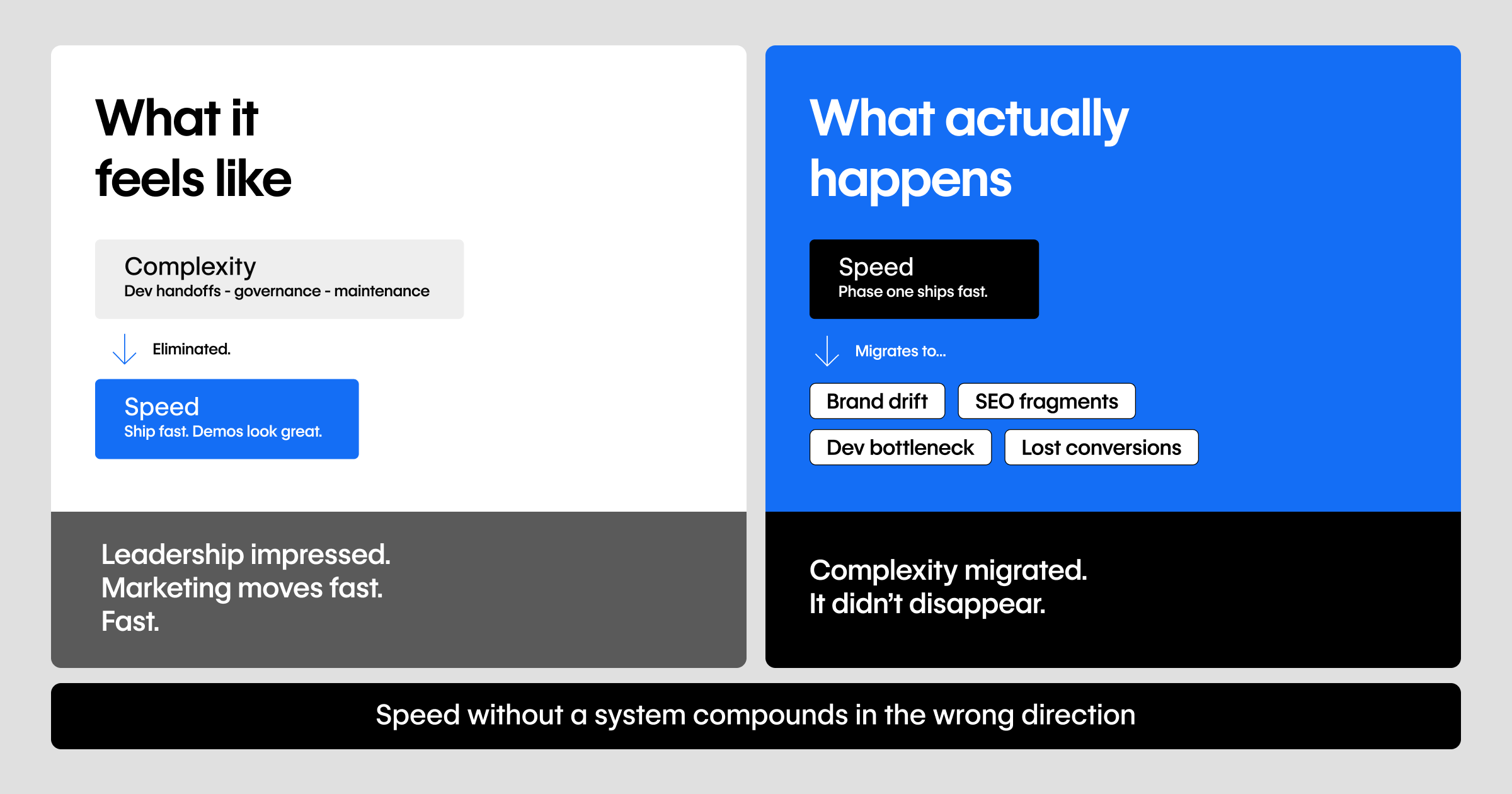
Teams ship fast. Demos look great. Leadership is impressed. The first few sprints feel like a genuine unlock. Finally, marketing can move at the speed of the business.
But what's actually happening is a transfer of complexity, not an elimination of it. The fragmentation doesn't disappear. It migrates into disconnected tools, a codebase only a developer can safely touch, SEO that nobody owns, conversion data that lives in three different places and reconciles in none of them. Brand drift sets in quietly, because suddenly, you need someone else to manage this system and help iterate.
This is the self-made trap: the faster you build without a system, the more of your future velocity you're mortgaging. Every fast build that lives outside a platform is quietly adding to a debt that will eventually come due, usually at the worst possible moment, when you're trying to scale a campaign, respond to a competitor, or onboard a new team member who can't figure out how anything works.
Speed without a system doesn't disappear. It compounds in the wrong direction.
That's the gap the third phase closes. And it's only possible on a platform built for all three.


















Two journeys. One destination.
We're watching two distinct patterns play out in the market right now.
The first: teams that start in Webflow and never leave. They build fast, ship with governance in place from day one, and compound from there. No detours. No retrofitting. The platform was the decision.
The second: teams that start with agentic development or headless architecture, move fast, ship something impressive and then hit the wall. Governance gaps. Developer bottlenecks. SEO fragmentation. A codebase nobody wants to own. At some point, someone asks the question that should have been asked at the start: how do we actually run this thing over time?
You can take either route. One of them is just longer.
For many teams, the fastest path to Journey 1 is through a Webflow agency partner — someone who's already built the governance model, already knows the platform, and can get you compounding faster than starting from scratch. The agency becomes an extension of the team, not a replacement for the platform.
What this requires: a new kind of marketer, and a new kind of platform
The modern marketer this moment is calling for isn't just someone who can use AI tools. That bar is already too low.
The modern marketer is accountable for pipeline, not just campaigns. They're expected to move at the speed of AI without sacrificing brand integrity or governance. They're operating at the intersection of creative, technical, and analytical in a way that didn't exist five years ago, and they need a platform that's built for all three, simultaneously.
Most teams are still building on top of point solutions — a headless CMS here, an optimization tool there, a hosting layer somewhere else. Each one best-in-class in isolation. None of them aware of the others. A headless CMS alone gives you a content layer. That's not enough anymore. What AI actually requires is an integrated stack — API-first by design, headless where you need it, visual where you want it, with context flowing across build, content, analytics, and optimization.
This is what we call an agentic web marketing platform, a system where humans and AI agents collaborate inside one governed environment to run the full web marketing lifecycle: build, manage, optimize, and continuously improve.
The deepest advantage is the context. Most marketing stacks are fragmented. There’s a design system in one tool, analytics in another, experimentation data somewhere else. An AI agent working across that stack is working blind. It can generate, but it can't learn.
Webflow gives AI the full picture: design system, CMS and content structure, analytics, experimentation signals, and publishing infrastructure, all in one place. That's what makes agentic workflows actually intelligent rather than just fast and what makes the iterate to impact loop possible.
We've seen it play out directly. Customers using Webflow's AI-powered SEO and AEO have seen roughly 75% more organic traffic growth compared to those not yet using these features, a pattern driven by consistent, AI-powered optimization across large content libraries without adding operational overhead. The full breakdown is here.
How to get started
The short answer: start with Webflow AI. It's the fastest path from prompt to published. No setup, no handoffs, fully integrated with your design system and CMS from the first keystroke.
Go deeper when the work calls for it:
- Complex interactive components — pricing calculators, multi-step forms, location finders? Use Code Components with your preferred AI codegen tool. The output lives in Webflow and stays editable by the whole team.
- Automated, multi-step web workflows — content updates at scale, personalization logic, integrations with your broader stack? Use our MCP to let AI agents operate programmatically inside Webflow's governed environment.
- Working in Claude or Cursor? These integrations make that handoff clean. Your work becomes a Webflow-native asset, not a one-off import someone has to maintain.
The closer your tools are to Webflow, the less friction between creation and production.
The question worth asking
The teams that optimized purely for build speed are already paying for it. Not dramatically, but in a slow, compounding way, with developer tickets piling up, brand consistency slipping, SEO fragmenting, and conversion data disappearing into disconnected tools. The trap was disguised as efficiency right up until it wasn't.
The question I'd ask any marketing leader evaluating their web strategy right now isn't "Should we use agentic development?" It's: "What's our system for making our website better every day, safely, at scale, without our developer becoming a bottleneck?"
And the teams that answer it first are the ones whose sites get faster every lap.