



The coding harness changed everything for developers.
Most people look at the last 18 months in AI and see better models. But that’s not the full story.
What’s actually changed in day-to-day work for developers is the harness. Tools like Claude Code can do more than generate code, they can read your file system, understand your project structure, run tests, and operate within the constraints of your codebase. The model got better, yes. But the orchestration layer, the “harness,” is what made results qualitatively different.
A coding harness is the thick layer of context, constraints, and tool integrations that transforms a general-purpose LLM into a reliable engineering collaborator. It includes the file system, the dependency graph, the test suite, the CI/CD pipeline, the git history.
Without it, you get impressive demos. With it, you get shippable software.
The question every marketing-focused developer or engineer should be asking is: what does the equivalent harness for marketing look like?
The missing piece in AI-powered marketing: context
The instinct from the developer world is to assume Claude Code, Codex, or any of its successors will simply extend into marketing. Write copy, generate landing pages, push to production.
But this misinterprets what marketing work actually is.
In software, the path from idea to shipped product is relatively deterministic. You write code, run tests, fix what breaks, and ship. The harness enforces correctness along the way.
Marketing doesn’t work like that.
The path from idea to shipped output is shaped by judgment at every step. Teams have to balance a brand voice, audience nuance, legal constraints, country-by-country compliance, campaign goals, channel context, and performance goals all at the same time. The “right” answer isn’t binary. It depends.
That’s why marketing teams have already built a lot of structure around the work: brand platforms, audience segmentation, messaging frameworks, and approval workflows.
Ask any marketer their biggest issues with AI, and nine times out of 10 you will get the same response: it’s fast, but the output isn’t quite right. It’s not completely on brand, doesn’t use brand-approved messaging, and doesn’t follow guardrails that teams spent months building.
As with coding, this isn’t a model problem; the models are extraordinary. It's a context problem.
What's missing is the layer that tells them who you are, what you stand for, and how you show up across different surfaces, audiences, and altitudes.
Without that layer, fragmentation sets in fast. Different teams start generating their own versions of the same thing, messaging drifts, tone shifts, or the same product is described five different ways, depending on where you look. Approval chains get bypassed because speed wins over consistency. Coherence breaks alongside quality, and once that slips, it’s tough for a brand to recover.
Developers in the engineering world solved this with the harness. Now, developers in the marketing world need to do the same.
The five layers of a marketing harness: a collaborative IDE built for the judgement-heavy reality of creative work
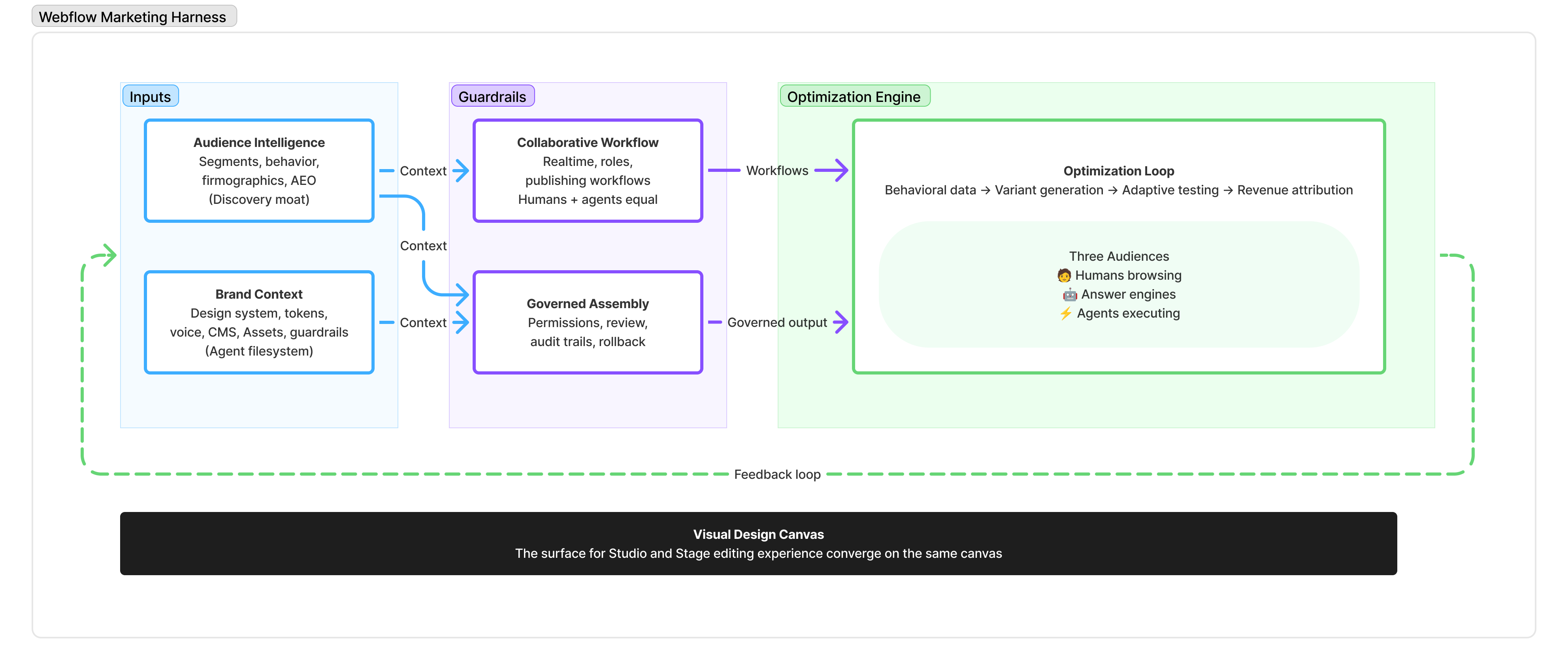
Drawing from what we've learned building Webflow's agentic web marketing platform over the past few months, we see five layers. Each maps to something developers will recognize, but the inputs come from marketing, legal, and ops rather than engineering.
Inputs
Brand context
This is the equivalent of a type system, but for brand. A queryable, enforceable system containing design tokens, voice guidelines, approved imagery, compliance rules, audience definitions, and competitive positioning. This is what's valid before generation begins. Marketing defines the schema. Agents compile against it.
A coding harness checks whether code compiles and tests pass in a binary way. A marketing harness has to enforce constraints that are softer and more contextual: brand voice and tone that shifts by audience, channel, and intent; roles and permissions that vary by content type, market, and campaign stage; compliance guardrails that change by geography and regulatory regime; design system governance that covers components, variables, and tokens.
These aren't linting rules. They're judgment-encoded policies that safeguard your brand based on contextual inputs.
The good news is that marketing has already done much of this work. Take Webflow’s marketing stack for example: plans are made in Asana and Google Drive. Brand teams use Cursor, Claude Code, Webflow’s MCP and our brand design system to design and house brand guides. The marketing harness takes all of that context and makes it queryable, versionable, and agent-readable.
Audience intelligence
A codebase has one target: the machine. Marketing could have dozens, split by persona, industry, buyer stage, and relationship type. Each requires different messaging, proof points, tone, and vocabulary.
The same product feature might be positioned as "governance" to a CISO, "speed" to a marketer, and "extensibility" to a developer.
On top of this, marketers are now speaking to three audiences simultaneously: humans, answer engines, and agents. A marketing harness has to produce output that is persuasive and emotionally resonant for people, structured and semantically clear for AI systems, and consistent across both without maintaining parallel content pipelines.
And this is where Answer Engine Optimization (AEO) lives inside the harness. When your content is properly structured against an audience intelligence layer, you build a foundation that feeds Google SEO, and AEO across Gemini, ChatGPT, Claude, and future answer engines with the same source of truth, adapted for each. The harness lets you produce and translate content for many audiences in the tail, including audiences you're serving invisibly through the AI systems they use.
This layer is not a static persona document. It's a dynamic system that maps audience segments to messaging frameworks, proof points, objection handling, and channel-specific adaptations.
Once built, the downstream value extends well past marketing. Sales gets outreach sequences tuned to a prospect's segment. Customer success gets onboarding content adapted to the customer's use case. Support gets response frameworks that match the tone each customer type expects. Partner teams get co-marketing assets that reflect the partner's audience. The audience intelligence layer becomes the single source of truth that makes all of it consistent.
Guardrails
Collaborative workflow
In a codebase, multiple developers can work on the same project because the file system is the arbiter. Git handles merge conflicts, and changes are discrete and serializable.
Marketing works differently. For example, a brand campaign might involve a designer, a copywriter, a demand gen lead, a product marketer, a legal reviewer, and an agency — all working on the same asset at once, building together in real time, building voice, visuals, tone and positioning live. The artifact is a living collaborative marketing asset, not just a set of files in a repo.
This layer supports genuine concurrent collaboration: commenting, version history, approval chains, and role-aware permissions that determine who can draft, review, or publish by content type, market, and campaign stage. Not "agent generates, human reviews" but humans and agents co-creating on the same platform.
Think of it as a collaborative IDE built for the judgment-heavy reality of creative work. The harness has to support concurrent human judgment, not just concurrent file access.
Governed assembly
This is the layer most developers jump to first, but it makes the least sense without the three above it. Agent identity, audit trails, and rollbacks. Every change, whether made by a person or an agent, passes through the same accountability system before reaching production. This is enterprise table stakes.
Agents building production-grade assets: landing pages, email sequences, campaign variations, structured data for AEO, all within the constraints defined by the layers above. The brand context operating system defines what's valid. This layer is where generation happens within those bounds.
And the output doesn't stop with marketing. The same generation layer that produces a campaign landing page can produce the sales deck that supports it, the customer success email sequence that follows the deal, the blog post that captures the category, or the support article that answers the inevitable follow-up questions. The harness, built once on marketing's guardrails, becomes shared infrastructure for every customer-facing team.
Optimization Engine
Optimization and learning
In software development, the agentic harness does more than run code. It ships, runs QA, progressively ships, measures performance, fixes bugs, and tightens the loop. That loop is what drives compounding improvement.
The marketing harness works the same way. Closed-loop feedback from performance data flows back into generation. If images with people convert better for a specific segment, the platform learns. If a CTO persona responds to technical messaging, the platform doubles down. If an answer engine is misrepresenting your positioning, the platform flags and remediates.
The deeper shift is structural. This loop moves you away from humans having to orchestrate everything. The platform becomes more autonomous over time, shipping, measuring, and iterating on its own output without requiring human intervention at every step.
That's what turns a marketing harness from a generation engine into a compounding intelligence platform.
This requires a purpose-built platform: Webflow has built one
You can't generate this from Claude Code, though you can use it tightly with Claude Code. You can't run it from markdown files in a git repo.
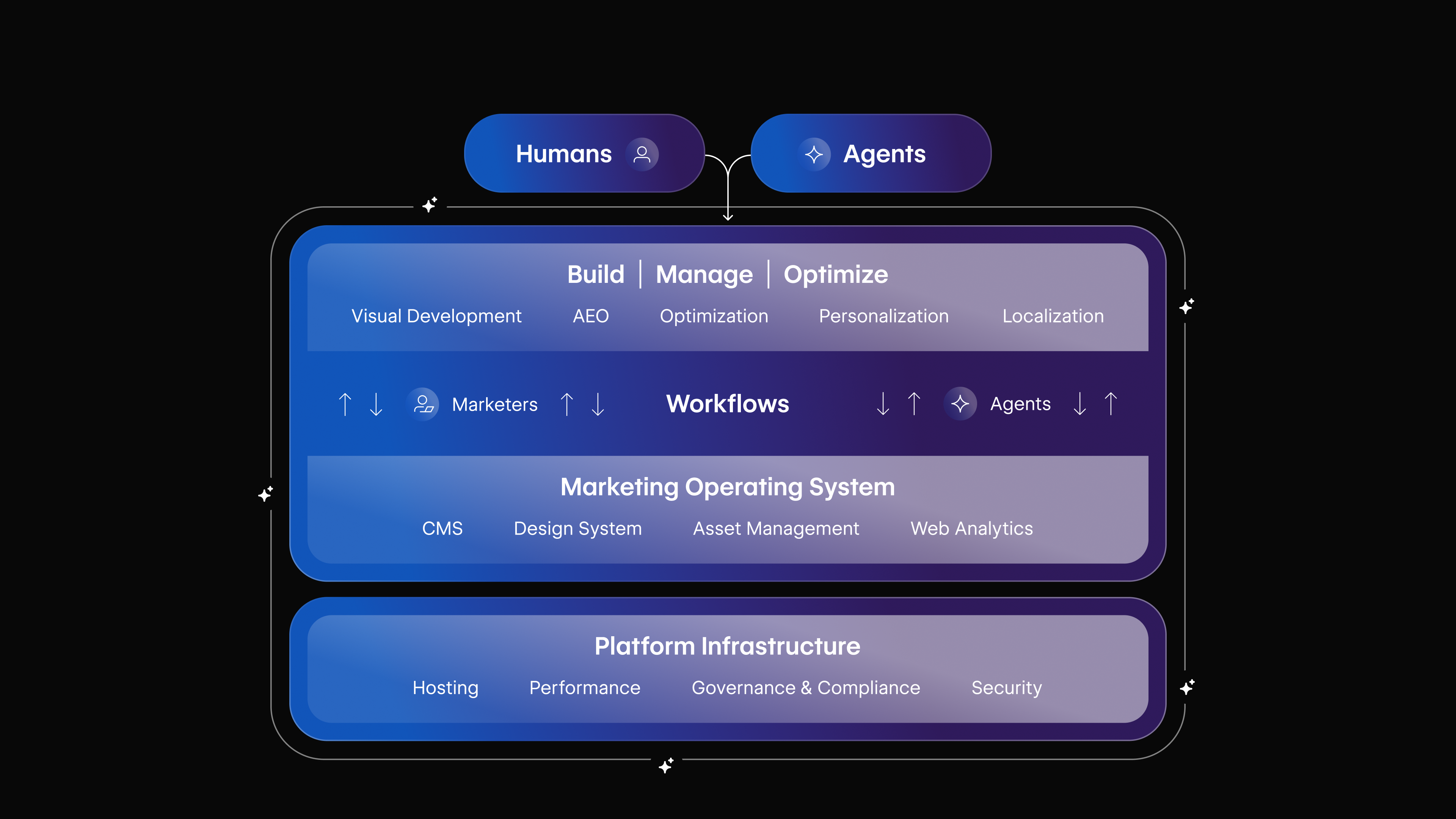
A marketing harness needs a visual and structured editing environment, a content model that encodes brand systems, audience data, assets, design systems, and channel adaptations, a governance layer, an API-first architecture, and a closed feedback loop connecting performance analytics to generation parameters.
This is exactly what Webflow has been building for years, and now through agentic technology, can fully realize the vision of a marketing harness.
Webflow is a sophisticated product with many layers. The visual web development platform that gives marketing teams direct control over their web presence, without writing code, was always a bet on giving developer superpowers to everyone. The CMS that separates content from structure. The Designer that makes design systems enforceable at the point of creation. The analytics and hosting infrastructure that connects publishing directly to performance. The API-first architecture that lets other systems plug into Webflow as the source of truth.
Each of those decisions was a layer of the harness before we called it that.
What's new is that now, you can leverage agents to 100x your impact as a builder and a marketer. And because Webflow already sits at the center of how marketing teams build, manage, and optimize their web presence, it's the natural place for the harness to live. The context is already there, the brand system is already there, and the audience structure and content model are already there.
We're now making all of it agent-readable, agent-enforceable, and composable across the five layers above.
Context is what makes AI output usable at scale
Without context, you get output that looks right, but doesn’t quite hold up. With context, AI starts to operate within the boundaries your team has already defined. That’s where the advantage starts to compound.
The companies that win won't be the ones that generate the most content. The winners will be those who leverage AI to 100x the impact of how their brand shows up in the world.